
POL BURY
Belgium, 1922-2005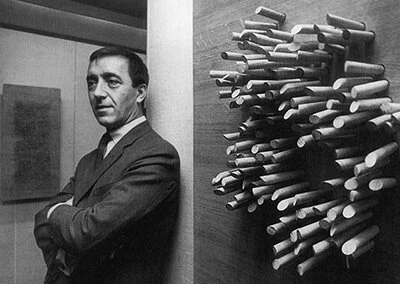
Pol Bury was a Belgian artist and a pioneering figure in kinetic art, renowned for his sculptures and reliefs that explore movement, time and perception. Born in Haine-Saint-Pierre, Belgium, he studied at the Academy of Fine Arts in Mons before joining the Surrealist group Rupture in 1939. Influenced by René Magritte and Yves Tanguy, he later became associated with the CoBrA movement and the Belgian avant-garde, before turning towards abstraction in the late 1940s.
In 1953, inspired in part by Alexander Calder’s mobiles, Bury abandoned traditional painting to develop his celebrated Plans Mobiles, followed by a series of motorised sculptures in which geometric forms move with extraordinary slowness. Working in wood, stainless steel and other metals, he created compositions of spheres, rods and cylinders whose subtle, almost imperceptible movements transform the viewer’s experience of space and time.
Throughout his career, Bury extended his practice to monumental sculpture, kinetic fountains, printmaking, jewellery, experimental film and writing. His public commissions include the celebrated fountains at the Palais-Royal in Paris and works for the Solomon R. Guggenheim Museum in New York. His work was exhibited internationally, including at the landmark 1955 exhibition Le Mouvement at Galerie Denise René in Paris and the Venice Biennale in 1964.
Combining poetic sensibility, mathematical precision and a fascination with the unpredictable, Pol Bury developed a distinctive artistic language in which stillness becomes movement and time itself becomes a material. He remains one of the most influential figures in the history of European kinetic art.
Kinetic Jewellery
Pol Bury brought his fascination with movement and perception into the realm of jewellery, creating sculptural pieces that blur the boundaries between art and adornment. Crafted in gold and other precious materials, his rings, bracelets, brooches and pendants translate the principles of kinetic art into intimate, wearable forms. Spheres, spikes and geometric elements create subtle movement and shifting visual effects, transforming each jewel into a miniature kinetic sculpture. Often produced in limited editions, these remarkable creations reflect Bury’s distinctive approach to form, material and motion, demonstrating how jewellery can become an autonomous work of art rather than merely an ornament.


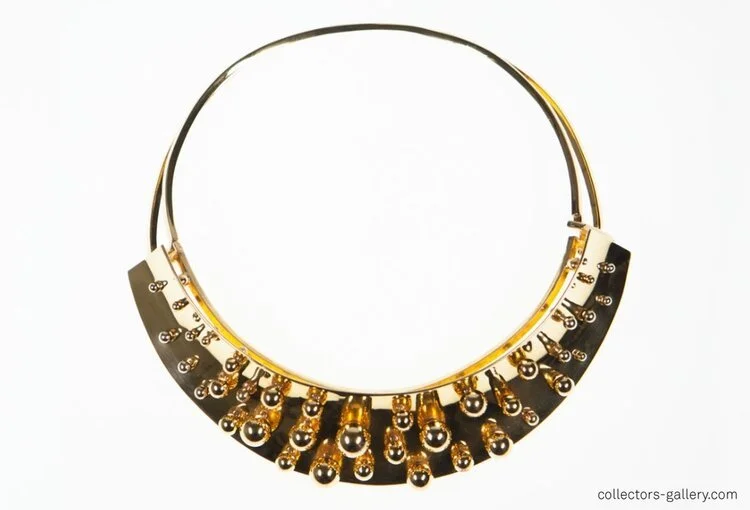
REF SQ5822547
Beautiful kinetic pendant decorated with moving spheres. Edition Artcurial Contemporary Art Center.
1987
Yellow gold 18K
Pendant : 5,8 cm x 4 cm
Markings : Artcurial 13/50 Pol Bury
In his original box. With certificate